Dressing Disorientation - Costume as a narrative tool in "The Father"
Presentation at Dress Devolution Conference, Falmouth University, 2025
The Father tells the story of Anthony and Anne, who are connected not only through their familial bond but also through Anthony’s advancing dementia. This progression forces Anne to make arrangements for his care, such as moving him into her flat and hiring a caregiver. While the film does explore the emotional strain of Anthony’s decline on Anne, it goes beyond that. This is where it diverges from most cinematic portrayals of dementia-related diseases. The film uses its medium-specific structure to create an immersive, subjective narrative that mirrors Anthony’s experience. Rather than offering an objective, external perspective, it pulls the viewer into Anthony’s disoriented reality. Costume design plays a key role in this, subverting its traditional function of establishing stable identities and marking the passage of time. As a result, characters, timelines, and events blur together, leaving the viewer as disoriented and uncertain as Anthony himself.
To achieve a fragmented style of narration, the film weaves together camera work, montage, lighting, production and costume design in a way, that every element contributes to the overall sense of narrative disorientation. Through montage, the linear timeline is broken apart, allowing the film to play with the structure of time: as a viewer, you're thrown into a mix of flash-forwards, flashbacks, and repetitions—often without initially realizing it. These timelines are connected in various ways. Sometimes a cut leads to a similar or even identical shot from earlier, but shown from a different angle. Other times, repetition is established through recurring dialogue instead of an explicit cut back to the beginning of a scene. The camera mostly reflects what Anthony sees—or remembers—including how people look and who they are, or at least, who they’re supposed to be.
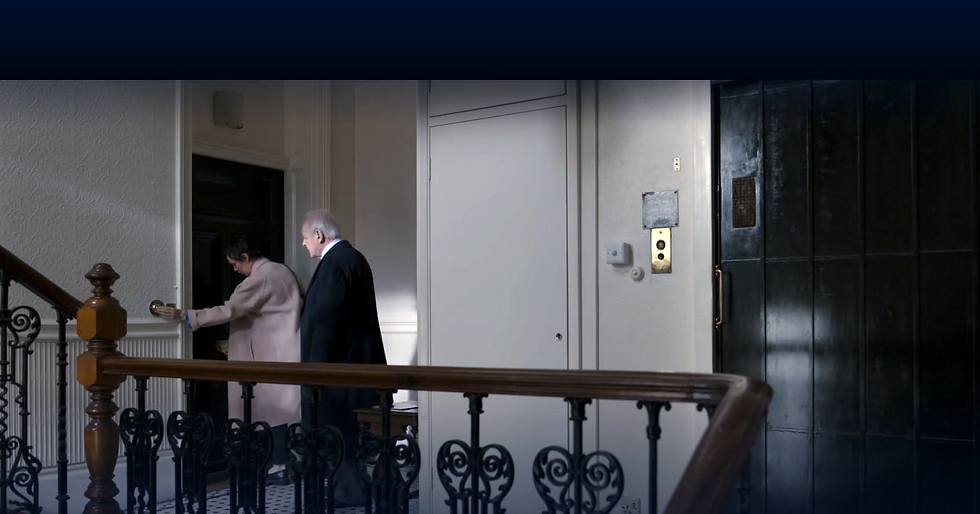

The first disruption occurs when Anne returns to the flat while Anthony is already confused by the sudden appearance of a man who has introduced himself as Paul, Anne’s husband. When Anne enters, she has not only changed her clothes, but her face as well. Where the character previously wore a blue blouse and black trousers, she is now dressed in an orange top and grey trousers. The only item that anchors this major slip in perception—both for Anthony and the viewer—is her beige coat. Everything else has changed, but this coat provides a link to the Anne we saw before. It grounds the moment in a shared reality, however unstable, and hints that this new figure might still be connected to Anthony’s daughter—even if only through his fractured memory. It’s even more unsettling than introducing a character with a completely new wardrobe would be, because it raises the question: how did this unfamiliar woman come into possession of Anne’s coat? Transferring a single piece of clothing to a different-looking character with the same name creates a simultaneous sense of recognition and bewilderment.

This strategy of shaping—and blurring—identity and time through costume continues throughout the film. There are two versions of “Paul,” both dressed in business-casual attire, but only one of them wears ties. When Olivia Williams reappears near the end of the film, she’s wearing Anne’s jewelry and a beige cardigan that evokes Anne’s beige coat. But she isn’t Anne—she’s now called Laura, the caregiver. The problem is, there’s already a character named Laura who also plays the role of caregiver. But that Laura only wears multicoloured knitted jumpers. Nothing fits together anymore. Nothing makes sense.
Beyond its role in narrative structure, costume is also used symbolically. The watch Anthony is constantly searching for represents his disorientation in time. While he frequently loses or misplaces it—along with his memories—everyone else wears their watches, remaining in control. Throughout the film, there are repeated mentions of getting dressed, and as the story progresses, Anthony spends more and more time in his pyjamas. Getting dressed becomes a symbol of self-expression, identity, and the ability to adapt one’s appearance to different situations. At the beginning, Anthony manages on his own, but by the middle of the film, there's a scene where Anne has to help him put on a jumper. In the end, when he is in the nursing home, he wears only a t-shirt and pyjama trousers. He loses all self-consciousness, no longer knows who he is, and asks for his mother. Unable to express his perception or hold on to his human identity, he says, “I feel as if I’m losing all my leaves… the branches, and the wind, and the rain.”

The Father doesn’t challenge stereotypical depictions of dementia and old age. But it uses its exemplary mise-en-scène, camera work, and montage to make the cognitive effects accessible. The costume design, by Anna Robbins, plays a powerful role in this storytelling technique, as it can only be fully realized through the thoughtful use of clothing. It shifts the viewer's perspective: by experiencing the destabilization firsthand, audiences may develop a deeper empathy and understanding of dementia, ultimately challenging traditional assumptions about aging and memory.

Kommentare